
Starting is easy now.
Not because your brain changed.
Because AI can hand you a first draft in seconds.
But staying the course? That’s where ADHD brains get wrecked. Not at the beginning. In the middle. When the novelty wears off, life gets loud, and your Goal Map starts to feel like a museum exhibit from a past version of you.
This post is for that moment.
The middle-of-the-project slump.
And how to use Goalbadger as a goal tracking app that doesn’t shame you with a red “late” list, but helps you re-map without losing context.
If you’re looking for the “how to build your first map” steps, that’s covered elsewhere (and we’re not recycling it here). This one is about resilient planning: the map can change, and that’s not failure. That’s the system working.
The slump is predictable
Here’s what usually happens:
Week 1: clean map, fresh energy, “this time it’s different”
Week 2: reality shows up (work, kids, health, executive function crater)
Week 3: guilt starts driving
Week 4: you avoid opening the app because it reminds you of “falling behind”
Traditional planners treat this like a discipline issue.
It’s not.
It’s a context-loss issue.
ADHD doesn’t just struggle with doing the task. It struggles with re-entering the task after a gap. You forget where you were, what mattered, what the next step was, and now the whole map feels unsafe to touch.
That’s why we built Goalbadger like a Goal execution engine, not a checkbox graveyard.
Re-mapping without shame
When life gets messy, you don’t need motivation.
You need a reset that doesn’t punish you.
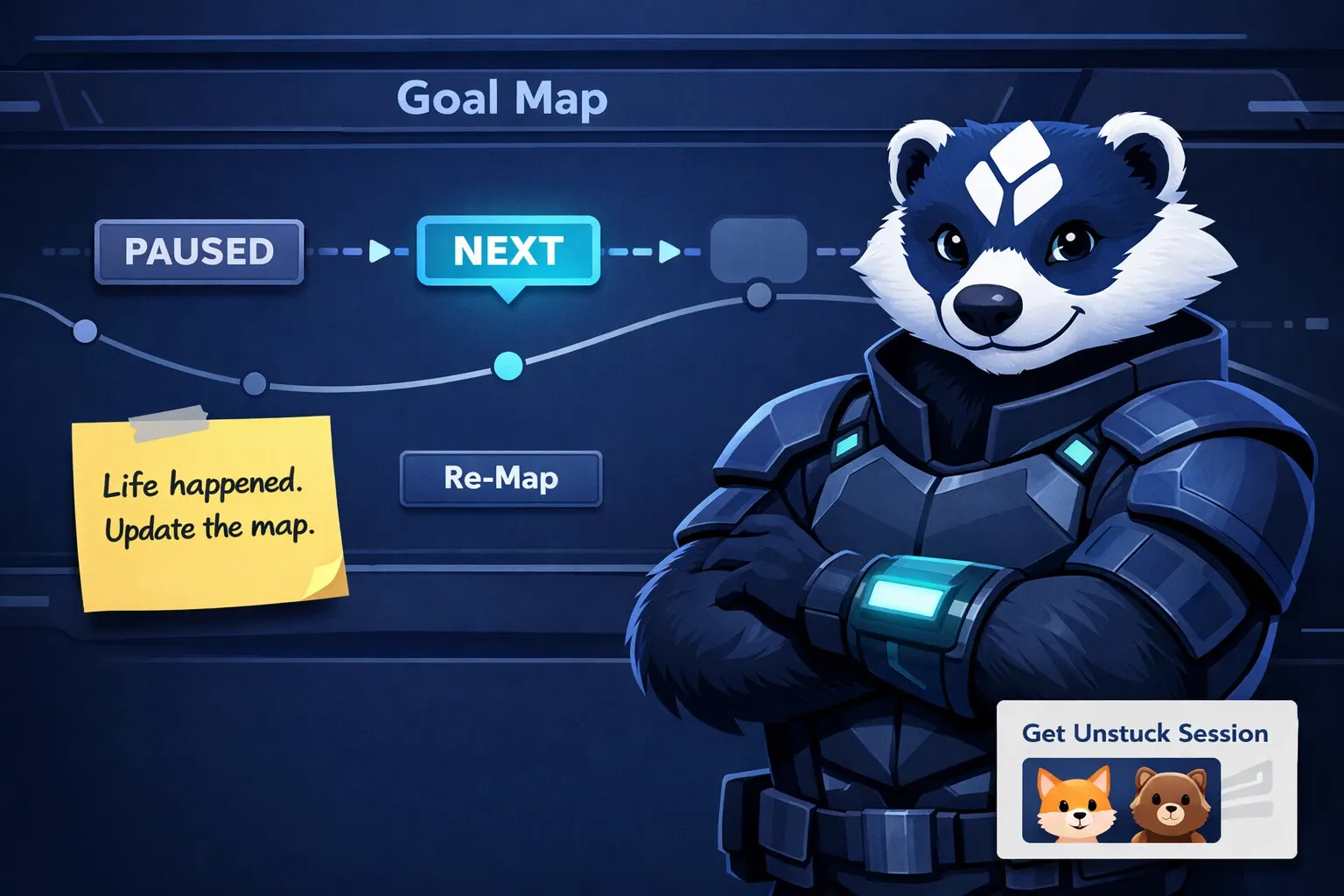
In Goalbadger, the move is simple: re-map the plan to match reality.
No “late” list. No backlog of doom. No pretending you’re the same person you were three weeks ago.
Your Goal Map is allowed to change. That’s resilient planning.
Use this quick loop any time you hit the wall:
Name what happened (one sentence)
“Work exploded.” “My meds changed.” “Family stuff.” “I burned out.”
No story. No trial. Just context.Pick the smallest honest target
Not “finish the project.” More like: “get back into the project.”Adjust the map, not your self-esteem
Move Phases. Pause Phases. Cut scope. Add a buffer Phase.
The point is to make the plan safe again.
Use Phases to pause and resume without losing context
Phases aren’t just “big steps.”
They’re bookmarks for your brain.
When you’re in the slump, the win isn’t grinding through tasks. The win is making it easy to return later without starting over.
Here’s how to use Phases for pause/resume planning:
Pause a Phase on purpose
If life is chaos, don’t keep a Phase “active” and guilt-staring at you. Park it. Label it clearly: “Paused - March (life happened)”.Add a “Return Ramp” Phase
Create a short Phase like “Re-entry” or “Warm-up week.” Put 3–5 tiny Pebbles in it.
Examples: “Read last notes,” “Review current Phase,” “Do one 10-minute task.”Keep one Phase as ‘Now’
ADHD hates juggling. Make it obvious what “current” means. One Phase gets the spotlight. The others can wait without yelling at you.Rewrite Phase names to reduce friction
“Finish marketing plan” → “Get back into marketing plan (no pressure)”
This is the key: you’re not “behind.”
You’re resuming.
And resuming is a skill.
Use your Clan for “Get Unstuck” sessions
Body doubling isn’t just for getting started.
It’s even more powerful in the middle, because it helps with re-entry.
Your Clan is perfect for low-drama “Get Unstuck” sessions. Not a status meeting. Not a mastermind. Just a short reset with another human in the room.
How to run it (15 minutes):
Post the stuck point (one sentence)
“I haven’t touched Phase 2 in two weeks and I’m avoiding it.”Share your current ‘Next Pebble’
One tiny task you can do right now.Do a timed sprint
10 minutes. Cameras optional. Silence allowed.Drop proof-of-move
Screenshot. Checkbox. One-line update. Done.
The goal isn’t accountability theater.
It’s traction. Together.
Resilient planning is the whole point
A rigid plan breaks the first time you miss a day.
A resilient plan adapts and keeps going.
That’s the difference between a normal to-do list and an executive function planner that supports real life.
So if your Goal Map hits a wall this week, don’t scrap it.
Don’t rewrite it from scratch.
Don’t spiral.
Just pivot:
Pause what needs pausing
Create a re-entry Phase
Pick one tiny next Pebble
Pull your Clan into a “Get Unstuck” session
That’s not quitting.
That’s becoming a Goalbadger.
Try the iPhone Beta or Explore our Goal Map Examples when you’re ready to re-map and keep moving.